Skip to content

Posts tagged ‘Home Health Nursing’

Amuse Me!

As often as I can, I try to for write you, my faithful and beloved readers, a blog  post that pertains to our industry.  I try with varied success to make it entertaining or at least interesting.  If it is neither, then maybe it is written because it is something that you really need to know.  Now, you may not like my sense of humor or you may be completely bored by my posts in which case I suggest that you make use of your browser’s back or delete button.  But I at least try.

Field nurses, on the other hand, do not seem to care that I am bored to tears reading their documentation.    Look at the following example:
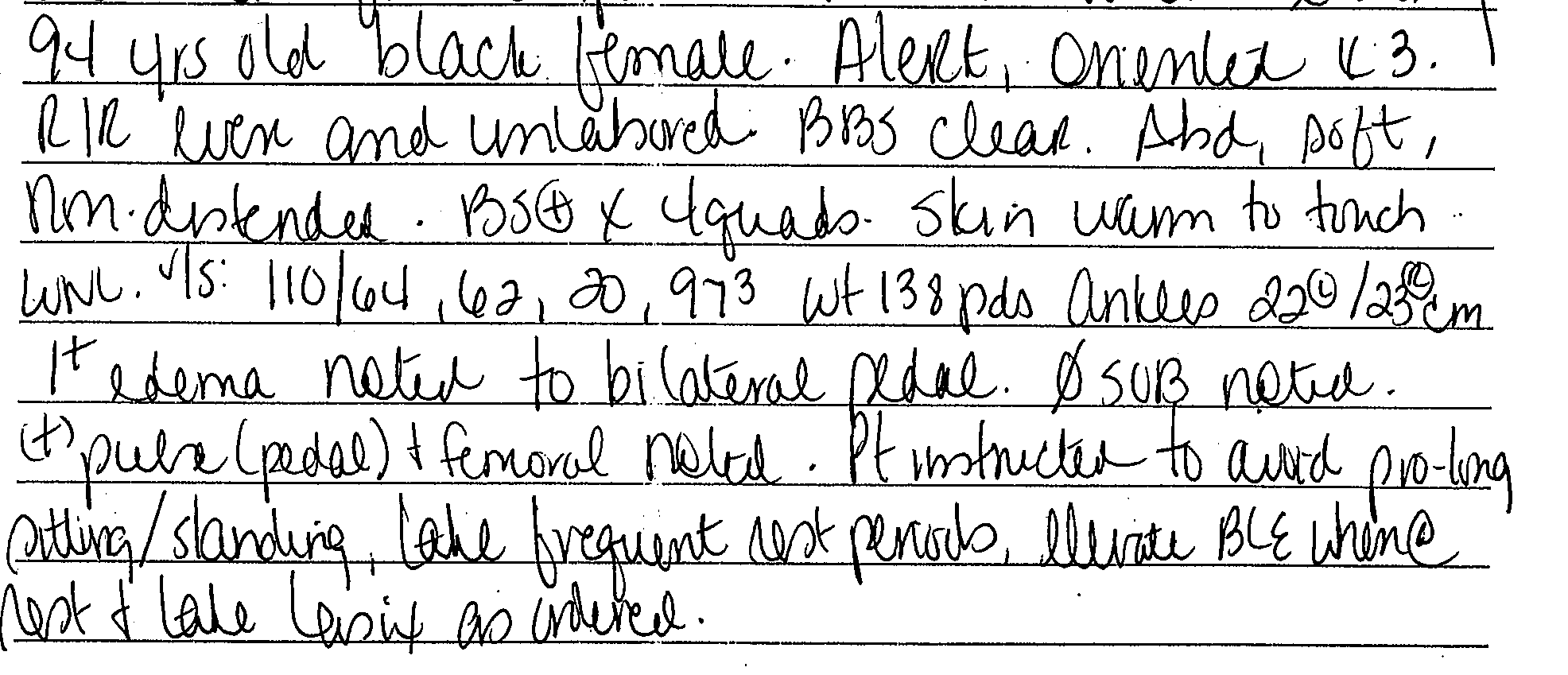
Actual Document

I can't make this stuff up.

There is nothing interesting about this documentation.  All of this with the exception of the teaching to take frequent rest periods and to take Lasix as ordered was on the flow sheet of the nurse.  I don’t care that the patient has bowel sounds in 4 quadrants.  I am so NOT interested in even and unlabored respirations.  Whoa, check out that amazing blood pressure!  Yippee.  The patient has the same pulses that are noted on the front of the visit note.

On the other hand, I know things that you don’t about this patient.  I know that she is also on potassium and I would have been interested in seeing that the patient was taught about the reasons why she needed to take her potassium as ordered along with the diuretic therapy.  Do you think if a patient keeled over due to low potassium that ‘taught to take Lasix as ordered’ will cover you in court?

Would that have been better than teaching a 94 year old patient with heart failure to avoid prolonged standing?  I am somewhat younger and no one has to teach me that!

What does, ‘take Lasix as ordered’ mean?  Again, I know things you don’t know.  I know that the patient has exceptionally poor vision, is at extremely high risk for falls and relies upon a walker to navigate in her home.  (You probably guessed that.)  Maybe it would have been better to teach the patient that when she took Lasix, it would be a good idea to be near ‘the loo’ as we called it in Australia.  Or if she had a bedside commode to make sure it was near to her after taking her Lasix to prevent falls.

Frankly, any good pharmacist will tell a patient how medications are to be taken.  It is the sole advantage of the home health care nurse to assess the patient’s ability to comply in the home environment.

Chances are if you cannot get me interested in anything you write, it is highly likely that you won’t be paid in a financial audit.  And that is the truth.  I am very interested in payment considerations.  So, tell me a story.  Prevent a fall and subsequent broken hip in an elderly patient.  Teach the patient something they can’t learn by reading Prevention Magazine or watching Television.  Remember that there are people out there paid to read nursing notes who have a burning desire to deny payment to your agency and I assure you that they have no sense of humor.

If none of that concerns you, think of me.  Yes, it is all about me.  Amuse me.

And above all, DOCUMENT WHAT YOU TAUGHT.

That’s all I have to say?  What say you?

What Were They Thinking

That is the question that runs through my mind when I review charts at agencies that do not have good quality review processes.

For instance, does the nurse who is teaching on Lortab know that the patient really doesn’t have an order for it on the plan of care?

What about the nurse teaching on Lasix for the sixth consecutive visit? How concerned is a nurse about her patient files a missed visit report but no follow up? Is the patient just laying there on the floor unable to answer the door? These are the questions that go through my mind when I read charts.

Then there is the documentation that is supposed to work as a catchall but actually serves as a ‘catch nothing’. Imagine reading on a chart of a patient with 22 medications that the nurse ‘taught side effects of meds’. That’s a lot of teaching for a single home health visit. It may have been a better use of time to choose one or two high risk medications and teach on those.

So are these just really crummy nurses? No. Does their documentation truly reflect the quality of the care they provide? I think not.

And it isn’t that these nurses are unable to learn. The problem is that it is difficult to teach an adult a skill that they have no use for. In the current regulatory environment, we are paid mainly because we send a bill to Medicare. No one is currently looking at the documentation to support claims. As such, documentation falls off on our priority list.

Can we say with any confidence that this will always be the case? Of course not. Too much attention is being placed on health care reform and how we are spending our Medicare dollar for us to expect the current level of scrutiny to continue.

And when the feds do come looking, it will likely be for clinical records that have long since been closed. In other words, the work you are doing now could be the subject of future reviews. Is your agency ready for that?

I hope so. If not, give us a call and we will get you ready. On the other hand, once the feds arrive, it may be too late!

If I Were a Recovery Audit Contractor

If I were a Recovery Audit Contractor, I know pretty much exactly how I would choose my targets for review. After all, we know that that the RACs can use statistical information from electronic sources to select agencies to review. By looking at aberrancies in data, I would choose the following triggers to guide me in my work:

  1. High case mix weights. This is pretty much a given since agencies with very low case mix weights may be under-billing.
  2. High therapy utilization. Nothing brings up a case mix weight more than therapy! Prior to 2008, there were many patients who needed 10 or 11 visits to meet the therapy threshold. Now the same patient might be assessed as needing seven or 14 visits! Very few patients receive 12 visits anymore.
  3. I would look for a lot of technical stuff. If I wanted to prove a diagnosis wasn’t appropriate, I would have a lot of clinical record review to get through. Then, when I adjusted the case mix weight based on diagnosis coding, I might find a couple of hundred dollars. On the other hand, if a physician didn’t date his or her signature, I get back the entire HHRG.
  4. All things being equal, I would choose agencies with very long lengths of stay. While it is true that a Medicare Beneficiary is entitled to unlimited episodes of home health as long as they have a qualifying need, documentation tends to become stale after a while. Homebound status is a little more difficult to discern by clinical record review but when I am reviewing clinical records, I can’t help but wonder about patients with multiple missed visit reports.

Does this mean that you should avoid patients who need therapy and have a high case mix weight. I do not see that as a valid answer. But when time is limited and you must pick and choose clinical records to review for completeness, these are the types of patients I would choose. I would also keep all these factors in mind at case conference. Front end protection in a RAC situation is most certainly better than trying to address problems after the record has been requested.

If you have comments or questions, please post below or email them. If you have any other ideas of what you would do if you were a RAC auditor, please share!

Nothing Special

It has been a long couple of weeks for me! Sometime in the middle of feeling overwhelmed, it occurred to me that I am living the life of many of our patient’s families.

My Aunt fell and broke her hip last week. My uncle, her husband is suffering from some sort of dementia and is unable to care for her. Because they live in a rural area, her surgery took place an hour north of their home and my uncle was unable to stay with her. Fortunately, my cousins drove him back and forth to visit.

Meanwhile, another cousin was admitted to the hospital in Baton Rouge. He is in ICU with a diagnosis of ARDS although no one can figure out the underlying cause. Needless to say, our family is spread thin, we are trying to make decisions and give advice long distance and we all feel inadequate because we are not able to be in two places at once.

What occurred to me over the weekend is how common this experience really is. How many times have you been into a patient’s home and learned of another relative either nearby or away that was also gravely ill. There is nothing special or unique about being pulled in multiple directions when more than one relative is ill.

And we have it made compared to many of our patients. This branch of our family tree includes many nurses and two physicians. All of us have cars and the ability to take time off work without worrying about being able to eat or pay bills at the end of the month. We are so much more fortunate than many of our patients and their families.

I know that I would forgive myself if I forgot to make a trip to the drug store or misunderstood some directions that a home health nurse gave me. I see my cousins who are not in the health care field try to make sense of all the information and how easily they become confused. Nurses and other health care providers spend years learning the vocabulary of our industry. What about the teachers and electricians?

And so when we are dealing with family members who are hopelessly non-compliant, I wonder if we are always fair with them? The fatigue of being vigilant all night long for a patient with a broken hip is exhausting. Waiting rooms are not a place to get rest.

Maybe in those first few visits when a patient returns from the hospital we should focus on teaching ONLY what is necessary and eliminating opportunities for confusion. Maybe we should focus on doing more than teaching. Implementing fall precautions with the permission of family members (lifting throw rugs, providing for adequate lighting, etc.) may be more effective than instructing someone who hasn’t slept well in several weeks. A simple phone call to follow up on medication compliance in those first few days may prevent serious complications due to the forgetfulness of fatigued family members.

It has only been a week since all this happened. I have a great family that’s actually pretty big. All of my family members have stepped up to the plate in this stressful time. And we are tired! My attitude towards seemingly non-compliant family members has changed tremendously. I hope you learn a little from my experience and that you keep it in mind both when taking care of patients and in your personal lives.

If you have any questions or comments, please email them or leave them in the box below.

Case Conferencing

When it comes to good patient care there is no substitute for case conferencing. In my years of experience, I have seen agencies who chose not to conduct a structured case conference, agencies who held a meeting where patients were discussed just long enough to meet minimum standards and I have seen agencies that make the absolute most out of a weekly or bi-monthly case conference. Guess which agencies do better overall?

With OASIS-C now a reality, there are even more reasons to conduct a thorough case conference that includes process measures. In doing so, discharge reviews will be much easier to perform.

These are some of the processes I’ve seen at various agencies over the years that make case conferencing more effective. Pick and choose those ones that you like and send us any other ideas we might not have heard.

  1. Prepare a list of patients up for recert in advance so that charts can be reviewed by the RN who will do the recertification visit.
  2. Invite all disciplines involved in care. I have seen some agencies where aides are not included. This is a critical mistake.
  3. Ensure that all the questions you want answered in case conference are addressed. You may want to make a short form or post the questions in the agency. That way the nurse who is reviewing the clinical record prior to case conference is aware of the information that she will be asked. Consider the following questions:
    1. Has the patient seen the doctor this episode and if so, why?
    2. Was any lab drawn? What are the abnormal results?
    3. Were there any medication changes?
    4. Was the patient taught on all medications?
    5. Did the patient go to the hospital at all? Why?
    6. Does the patient have heart failure? If so, what are the weight ranges?
    7. Does the patient have diabetes? What are the blood sugar ranges?
    8. Did any falls, injuries or other adverse events occur during the episode?
    9. Did the patient have a wound? Describe at beginning and end of episode. State wound care and any changes that occurred in the last episode.
    10. How was the patient’s pain managed? Were any interventions implemented with or without success?
  4. If a staff member is not able to attend, try to include them on the telephone.
  5. Get signatures of all attendees.

Or you could just pull the staff in from the field, feed them donuts and do the bare minimum to demonstrate compliance to the care coordination condition of participation. Either way, it costs whenever you bring field staff in for mandatory meetings. Why not get the most for your dollar?