Skip to content

Posts from the ‘coordination of care’ Category

Short and Sweet Documentation Quiz

So, I spend a lot of time trying to teach nurses how to document.  I really don’t enjoy as much success as I would like but it isn’t for lack of trying.

After reading charts from agencies chosen for ZPIC audits, I decided it would be easier to teach you how NOT to document.  Please understand that if you document like the examples in our little documentation quiz that I cannot help you.  The best lawyer in the world probably cant even help you except to maybe reduce your prison term.

Take the quiz.  I can’t wait to see your answers.

Medication Competency

Vicodin
Zocor
Lisinopril
Synthroid
Norvasc
Prilocec
Zithromax
Amoxicillin
Metformin
Hydrochlorothiazide
Xanax
Lipitor
Furosemide
Metoprolol
Ambien

This list of the top 15 drugs prescribed in the United States thus far in 2011.  The good news is that they are all generics meaning they are available at a lower cost.  The bad news is that because they have become so common, we forget that these are major pharmaceuticals that can cause major problems.

If you’ve been paying attention, you will realize that the key to doing well in 2012 is directly related to your ability to keep patients out of the hospital.  In reviewing hospitalizations and  Reason for Transfer OASIS assessments, I would bet the farm that medication errors are a direct or indirect cause of a lot more hospitalizations than are reported.

When I read charts, I also see very vague medication teaching.  In reviewing clinical records it is not unusual to see ‘teaching’ such as:

  • Taught patient to take meds exactly as MD ordered.
  • Call MD for any side effects.
  • Take insulin at the same time each day.
  • This medicine helps to lower your cholesterol

I understand that patients have different learning abilities and that sometimes the best we can do is teach the patient the bare minimum.  But whether we teach a lot or a little about medications, it isn’t working.

The first step in providing really effective teaching about medications is to know your medications.

To see how well you or your staff know your meds, click here to take a basic medication competency test.  Until you are able to answer the questions with complete confidence, keep researching.

Of course, not every can know every medicine but there are tools that can be used.  My favorite for when I work offsite is the Medscape app (available for iPhone, Droid and Blackberry) which has two options for download.  One is a smaller download and the larger download includes the entire database for use offline.  Using the larger download option, nurses are able to look up drugs and interactions on their phone even when the internet isn’t available.  It is amazing the things I find when I use it.  The downside of the app is that it does provide every possible drug interaction in the world.  I try to focus on the most serious interactions and read through the remainders to see if they apply to a particular patient.

By really looking at meds and planning teaching as you write a careplan, you can gather all sorts of appropriate teaching materials for the patient.  Medications are also my favorite hunting ground to see if any diagnoses have been missed.

Let me know what you think about the competency test and how you scored.  If you have any other questions to add, please feel free to email them to me or to post below.  Heaven forbid I made an error in the test.  If that’s the case, please post below.

Tis the Season…..

Almost nobody is stupid enough to run a computer or a network without virus protection. Those that are, often find that their machines are worse than useless in a few weeks if they are lucky. If they are not lucky, people all over the world are shopping with their credit cards, transferring funds from their bank account and sending annoying spam to all of their friends.

So it makes sense that an enormous amount of time, energy and expense is devoted to protecting our computers against viruses. And yet…… aside from a statistically insignificant number of suicidal IT techs, a computer virus has never killed anyone.

The Flu, on the other hand kills thousands of people each year. If we spent a fraction of the time trying to prevent flu in our community by providing virus protection which is free to most of our patients, we would save lives. That’s a good thing, I think. Healthcare Reform has raised some payment issues. But, as always, I digress.

There are a lot of arguments against getting the flu shot. One quick search on the internet will alert you to the fact that the flu vaccine is ineffective and kills people. Therefore, all of these unlicensed medical pontificators have advised the rest of the internet against taking the flu vaccine. One man in Canada died of anaphylaxis after a routine flu injection. Another blogger accused the healthcare industry of lying about the possibility of anaphylaxis and covered it up by calling it a ‘severe allergic reaction’. The Internet School of Medicine is apparently not hosted by an Ivy League facility.

First of all, about 35,000 people die each year from the flu. Other than the dude in Canada, I do not see any reliable statistics about deaths from the flu vaccine. One and a half people out of a million will have a serious allergic reaction (also known as anaphylaxis for the ISM crew), and some people feel crummy for a day or two as their immune system kicks into action. This is not the same thing as the flu.

There are some agencies who will decide not to give the flu shot. Depending on your state and the pharmacy laws, that is understandable. However, if your agency decides not to administer flu vaccine, that doesn’t mean it isn’t just as important to educate your patient and their family members on the importance of being vaccinated.

Remember that all patients currently admitted, assuming they are on service until the end of episode will have at least part of their episode in the current 2011-2012 flu season.

This is easy folks. Let’s save a few lives this year. Start by getting your own flu shot. Your patients will appreciate it. So will your family.

Please feel free to email with any brilliant ideas for effectively promoting flu vaccines among staff and patients. As nurses working together we can make a serious dent in the damage the flu does to our collective patients this year.

Amuse Me!

As often as I can, I try to for write you, my faithful and beloved readers, a blog  post that pertains to our industry.  I try with varied success to make it entertaining or at least interesting.  If it is neither, then maybe it is written because it is something that you really need to know.  Now, you may not like my sense of humor or you may be completely bored by my posts in which case I suggest that you make use of your browser’s back or delete button.  But I at least try.

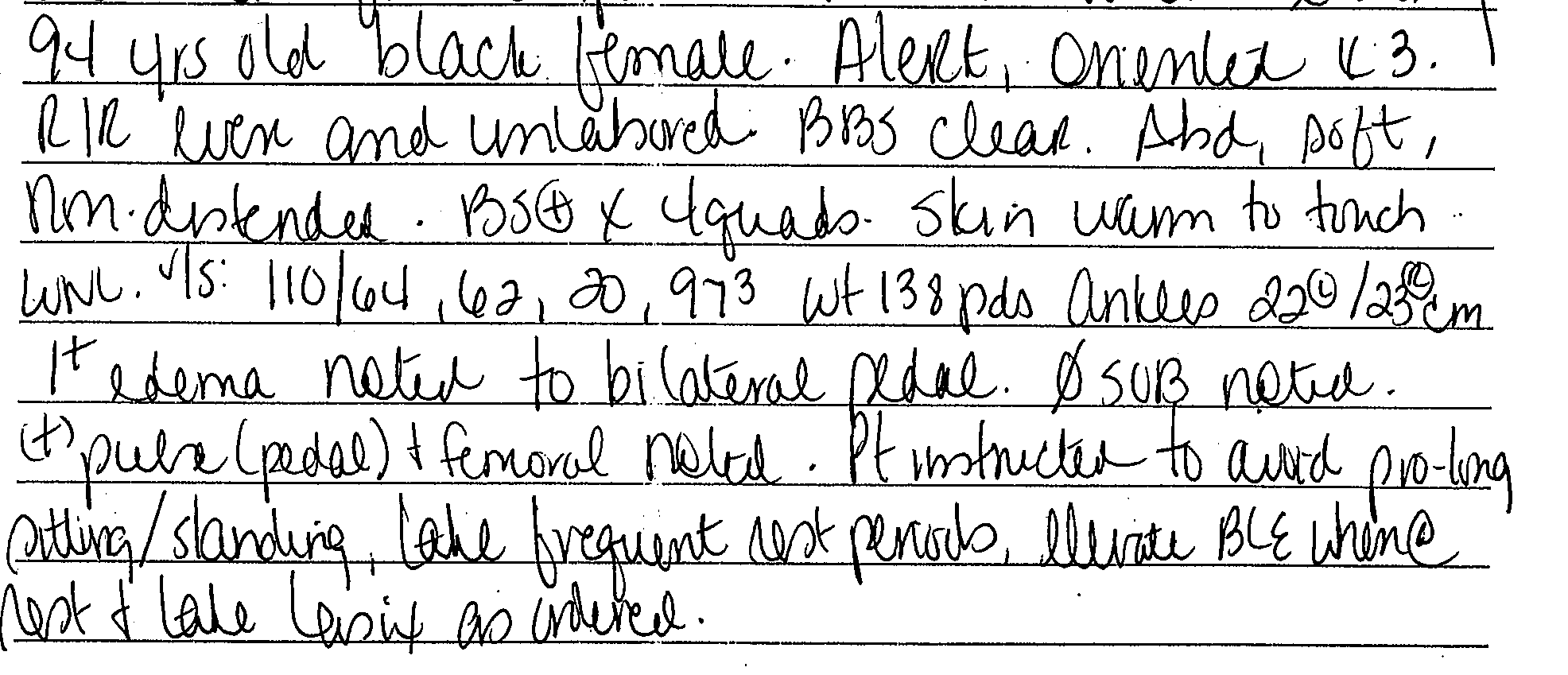
Field nurses, on the other hand, do not seem to care that I am bored to tears reading their documentation.    Look at the following example:

Actual Document

I can't make this stuff up.

There is nothing interesting about this documentation.  All of this with the exception of the teaching to take frequent rest periods and to take Lasix as ordered was on the flow sheet of the nurse.  I don’t care that the patient has bowel sounds in 4 quadrants.  I am so NOT interested in even and unlabored respirations.  Whoa, check out that amazing blood pressure!  Yippee.  The patient has the same pulses that are noted on the front of the visit note.

On the other hand, I know things that you don’t about this patient.  I know that she is also on potassium and I would have been interested in seeing that the patient was taught about the reasons why she needed to take her potassium as ordered along with the diuretic therapy.  Do you think if a patient keeled over due to low potassium that ‘taught to take Lasix as ordered’ will cover you in court?

Would that have been better than teaching a 94 year old patient with heart failure to avoid prolonged standing?  I am somewhat younger and no one has to teach me that!

What does, ‘take Lasix as ordered’ mean?  Again, I know things you don’t know.  I know that the patient has exceptionally poor vision, is at extremely high risk for falls and relies upon a walker to navigate in her home.  (You probably guessed that.)  Maybe it would have been better to teach the patient that when she took Lasix, it would be a good idea to be near ‘the loo’ as we called it in Australia.  Or if she had a bedside commode to make sure it was near to her after taking her Lasix to prevent falls.

Frankly, any good pharmacist will tell a patient how medications are to be taken.  It is the sole advantage of the home health care nurse to assess the patient’s ability to comply in the home environment.

Chances are if you cannot get me interested in anything you write, it is highly likely that you won’t be paid in a financial audit.  And that is the truth.  I am very interested in payment considerations.  So, tell me a story.  Prevent a fall and subsequent broken hip in an elderly patient.  Teach the patient something they can’t learn by reading Prevention Magazine or watching Television.  Remember that there are people out there paid to read nursing notes who have a burning desire to deny payment to your agency and I assure you that they have no sense of humor.

If none of that concerns you, think of me.  Yes, it is all about me.  Amuse me.

And above all, DOCUMENT WHAT YOU TAUGHT.

That’s all I have to say?  What say you?
Documentation – Again!

So, I am sitting at my desk reviewing clinical records for any number of reasons for any number of clients.  The ZPIC charts are the ones that tell the story.  It isn’t that they are any worse than any of the others.  Rather, they are the only ones that are reviewed in their entirety through multiple admissions and discharges for a period of two to three years.  That’s a lot of visit notes.

So, today, I am reading a chart of a 95 year old patient and when I start on episode three I noticed that she had fallen.  I jumped up from my chair and yelled with excitement.  Finally, something happened to the patient that warranted continued services.

Yes, folks.  That’s how low I’ve fallen in these dark days of clinical record review.  I am now celebrating when a 95 year old woman falls to the floor.  I find this mildly discomforting.

Now, just like all the other charts and all my other clients, when I call the nurse, I hear all sorts of things.  The patient had lost her medications for a few days or there was an unstable caregiver situation and numerous other things that warrant care from a home health agency.  But they are not in the chart.

And before I go to these agencies fully armed and ready for action, I have to have one of those talks with myself.  The vast majority of my clinical background is in the CCU’s.  I am proud to say that patient care always came first with me but I seriously doubt that my documentation would have withstood the kind of scrutiny that our small sector of the industry is subject to now.  I am once again reminded how there is often very little correlation between quality of care and quality of documentation.  Some of us just have better things to do.

And in the interest of fair disclosure, let me say that I really don’t know a whole lot of nurses who have lost their license, been sued and have their lives ruined because of poor documentation.  There is a really good chance that your documentation will never result in such a drastic outcome.

But I do know some nurses and agency owners and others who are in jail.  I know some nurses who are struggling to feed their families because they lost their license and we really aren’t qualified to do much else.   I know of a nurse who charted pedal pulses on a bilateral amputee.  She wasn’t trying to commit fraud.  She simply charted the same thing she always did out of habit one night when she was tired.  It didn’t help that her lawyer said to the state board of nursing, “So, you are telling me there is no place else in the body that you can have pedal pulses?”

So, the choice is yours.  You can play the odds and hope they stay in your favor or you can document correctly.  If you think about it, the odds are also in your favor should you choose to play Russian roulette.  You don’t play the odds with your life and you shouldn’t play the odds with your career.

Now I will get back to work and hope that the 95 year old falls again or better, gets an infection with a whole lot of medication changes.