Skip to content

Posts from the ‘general’ Category

Data Submission

Have you submitted your OASIS data?  All of it?  Have you looked at your validation reports in great detail to ensure that there was not one fatal error that may have been overlooked?

What about your HHCAHPS data?  Have you been diligent about submitting it?  If your agency had less than 60 patients from March 31 through April 1, have you submitted an exemption request on the HHCAHPS website?

If you are not 100 percent sure about these answers, it might be a really good time to find out and ensure that  you have met your data submission requirements.  You will be penalized if your OASIS and/or HHCAHPS data isn’t submitted.

The penalty sounds modest enough – 2 percent.  But unless you are really good at doing business or really bad at taking care of patients, that 2 percent could be anywhere from 20 to 50 percent of your margin.  If you are really good at taking care of patients and mediocre in the business area, this modest 2% could devastate you.

The Medicare Guidance, which can be found here, reads:

In calendar year 2007 and each subsequent year, if a home health agency does not submit required quality data, their payment rates for the year are reduced by 2 percentage points.

Notice the reference to the year 2007?  The actual reg has been in effect even longer than that and only a couple of agencies here and there were penalized.  The Office of the Inspector General took notice of that earlier in the year and penalties are on the way.  The  Medicare Administrative Contractors (MAC’s – formerly FI’s also known as Palmetto, Pinnacle, etc.) have received these instructions straight from CMS:

Each fall, Medicare contractors with home health workloads will receive a technical direction letter (TDL) which provides a list of HHAs that have not submitted the required OASIS and/or HHCAHPS data during the established timeframes. These Medicare contractors shall review their paid claims history for claims which have:

  • a provider on the (naughty) list
  • Dates of service from July of the previous year
  • Beneficiaries over 18

Here’s the part that is really good:

If the contractor finds any such claims, the contractor shall notify the HHAs that they have been identified as not being in compliance with the requirement of submitting quality data and are scheduled to have Medicare payments to their agency reduced by 2%.

I have yet to see where a threshold for compliance has been set.  It does not say if the majority of data was submitted or if 90 percent of the data was received.

It also doesn’t say how they are going to identify the providers.  Will they look for gaps longer than 3o days between submissions?

My experience is not reassuring.  Agencies have received deficiency notices for late submissions but there have a number of times over the past few years when no data was submitted.  Nothing has been received when no data was submitted.

In one agency, a young lady had indeed submitted the data and placed the validation reports in a binder just as she was told.  Her instructions should have included reading the reports.  Every single assessment had been rejected for a period of six months.

Several times in several different agencies, the person responsible for data submission left employment.  When they did, nobody picked up the relatively insignificant task of transmitting data.

If I were an administrator or a Director, you can prevent disaster by:

  • Requiring OASIS data to be submitted every two weeks.  It is not unheard of that uploading data is difficult and time consuming
  • Require written confirmation that the task was done.
  • If you use outlook, put a recurring reminder with an email that goes out two days before data is to be uploaded.  That way, if you forget about all this a year from now and the person uploading the data leaves, you will get a bounced email
  • Actually look at validation reports and ensure they are being addressed.
  • A system of verifying with your HHCAHPS vendor that submission of data has occurred according to your contract.

If you are a field nurse or someone else who doesn’t deal with OASIS transmission, don’t hesitate to bring a copy of this to the people who do to remind them of the importance of it.  If they are offended, walk it off as my son’s coaches used to say.  I can pretty much guarantee that you will not get a raise next year if your agency takes a 2 percent hit.

Reducing Fraud

Everyone agrees that the industry has had enough of fraud.  In fact, some industry leaders have already declared, ‘Enough is enough!’.  I wholeheartedly concur with that eloquent and emotional pronouncement of the common values of Home Health Providers.  So lets take a look at how we can reduce fraud and cut the home health budget, shall we?

  1. Ensure that nobody gains entry into the Medicare program without undergoing a criminal history background check.
  2. Test all owners and managers according to standards set forth by The Secretary to ensure that all owners and managers understand HIPAA, coverage guidelines, compliance rules, marketing guidelines, etc.
  3. Require providers to put up a 100K surety bond and demonstrate they have the capital to operate.
  4. Mandate compliance programs or if you prefer, ‘Promulgate rules requiring home health agencies to have in operation a compliance and ethics program designed to prevent and detect criminal, civil, and administrative violations’.
  5. Do not issue provider numbers in geographical areas where there is a lot of fraud or where there are a lot of providers.
  6. Put a Cap on Episodes much like IPS.  Urban agencies will be limited to less than two episodes in the aggregate and rural agencies can go up to 3.2.
  7. Penalize agencies who do not bill for LUPA’s.
  8. Have the MACs (FI’s) perform a payment review on  a random sampling of claims in all agencies to make assumptions about the agency based upon OASIS data prior to paying claims to ensure accuracy of claims.  I am available at my hourly rate to assist agencies in this process which resembles RAC audits.
  9. Place all new agencies or agencies that acquire new provider numbers to  them on a 100% percent prepayment review of claims.
  10. Get rid of the therapy thresholds.
  11. Tighten up the face to face encounter time frame so that all patients except those who have just been discharged from the hospital must be seen within 14 days of admission..
  12. Allow Nurse Practitioners to sign plans of care.

It is possible that one or two of you are sitting there wondering how I ever became so brilliant and are willing to stand up and fully support these recommendations.

It is equally possible that some of you think I am knitting with one needle or that my IQ  roughly equals room temperature this weekend.

As such you would all be wrong.  These suggestions have already been presented to Congress by The Limited Partnership for Quality Home Health Care.   Click on the link to view the eight (8) members of The Partnership.  Is anyone surprised by anyone on the list?

In case you think that Bill Borne and his friends are just trying to mess with me, I encourage you to read their petition to congress.  It describes an entire proposed Act of Congress called the SHHIPS Act.

I have never had an act of congress – even proposed – named in my honor.  I want a Planet Wackadoo Act that eliminates stupid and/or greedy people from health care.    Better yet, what about a Put Patients First Act that prohibits determining care based  upon arbitrary numbers that coincidentally benefit the Elite Eight at the expense of the group of the other approximately 6,000 home health companies in the country?

As the week goes by, I will share my thoughts on the individual recommendations.  Meanwhile, we have a voice.  If you have any strong opinion about the SHHIP  – even if you disagree with me, use your constitutionally guaranteed right to be heard by those you elect to office. 

Now, go for a long walk, get some tea and clear your head.  We have work to do.

Please Read Aloud


Please read the following paragraph aloud to yourself or to a coworker.

1 eV is equal to the amount of kinetic energy gained by a single unbound electron when it accelerates through an electric potential difference of one volt. In plain numbers, 1 eV equals 1.602176487(40)×10−19 Joules. In comparison, a single molecule floating in air has the energy of 0.04 eV.

Having completed this little exercise, are you able to work with subatomic particles?  Is your coworker competent in operating large hadron colliders?  Do you have any idea what I am talking about.

If you do know what I am talking about, please explain it to me.  I am clueless.  But, I can verbalize understanding of the amount of kinetic energy 1 eV equals.

Every day I read that patients verbalize understanding of information that is not required to help them improve their overall health status.  Many times the probability the patient actually understands how to apply this useless information to their daily lives is pretty much zip.

We even have an abbreviation for Verbalizing Understanding. It is used with such frequency that the abbreviation V/U shows up daily in visit notes, goals, etc.

Here’s a secret.  I don’ really care what the patient understands.  I only care about the end result of our care.

Ten fingers and a key board is pretty much all it takes to verbalize understanding of pretty much anything.  Changing behavior is a far loftier goal than merely verbalizing understanding.

Consider the following two goals.

  1. Patient will verbalize understanding of diabetes diet by end of episode.
  2. Patient will have blood sugar ranges between 70 and 150 throughout episode.

The design of the second goal shifts the thought process in care planning slightly to the left.  The nurse taking care of the patient is no longer bound and determined to teach the patient all the biochemistry involved in the way the body uses insulin to transport glucose across cell walls how pH and electrolytes are influenced by a lack of insulin. This makes about as much sense to some patients as subatomic particles makes to us.

In order to meet the second goal, the nurse determines why this particular patient has a high sugar and work with the patient to change the behaviors contributing to a poorly managed disease process.  Whether or not the patient can verbalize understanding is not nearly as important as reaching the goal of a healthy blood glucose level.  This may be a simple as getting the patient to trade out his cokes for diet coke or as complicated as involving the entire family for whom eating cake has been a way of celebrating everything from birthdays and holidays to successfully tying one’s shoelace in the morning.

I am quite certain there are patients who will benefit and use a sound understanding of their disease process to improve their health. In these patients, the second goal works just as well.

It all depends on the patient.  Got that?  It depends on the patient.

The Supreme Court’s Non-Ruling

I think we all agree that there is nothing more interesting than a 200+ page ruling from the second highest court in the land.  (The first highest court is a basketball court on the fifth floor of the Supreme Court, three floors above the courtrooms.)  The real question to us a nurses and providers of care paid for by Medicare is what, if anything does the ruling mean to us.

Maybe nothing.  We still get up in the morning, take care of patients or assist those who do, bill for care and maybe even get paid.  The rules affecting us written in the ACA for the most part have already been enacted. The lovely face to face encounter we all embraced with open arms when it was announced is probably the greatest contribution affecting home health and hospice directly.

For those of you who do not share my passion for the Supreme Court, here’s the cliff notes version.  The Affordable Care Act was introduced under Congress’s authority to govern ‘commerce’.  Commerce  involves the sale or exchange of goods for money or other goods.  When I buy a car, the dealer has to abide something called a ‘lemon’ law which is a ridiculous use of a word that describes a fruit, a color and a can make you salivate just by reading it twice.  (See?)    When I buy a house, the seller must disclose certain facts to me regardless of how unpleasant they are such as history of flooding or termites.

What Congress cannot do is force me to engage in commerce.  In other words congress can dictate certain terms of my transactions involving cars or houses but they cannot force me to buy a car or a house.

Make no mistake.  The nine justices on the Supreme Court are exceptionally bright individuals.  They do not make laws or enforce them.  Their ONLY job is to determine if rulings by lower courts fall within the guidelines of the US Constitution.  You remember that little document with all the signatures that talks about life and liberty and such?  Good, because a lot of our lawmakers seem to think it’s obsolete.

The justices said that if Congress is going to make people spend money or give it to the government, it doesn’t matter what it is called, it serves as a tax.  So the ‘penalty’ imposed by the ACA for not purchasing insurance is actually a tax. A rose by any other name….  I wonder if there would have been more public outcry against the ACA if the American public knew it was a tax?

Are you still with me?  Stay awake or I will get out the squirt gun with ice cold water and wake you up.  A recap:

  1. The Affordable Care Act proposes to make people buy insurance or pay a penalty.
  2. Congress thought they could do this under their powers to govern ‘commerce’.
  3. The Supreme Court disagreed and said it was really a tax.

Why does this matter?  Here’s what you have all been waiting for, folks…..

You cannot repeal a tax until it is implemented.  There is no prepealing of taxes.

So, we end up with the biggest punt in the history of United States Justice.  The Supreme Court of the United States did not rule on the constitutionality of the Affordable Care Act.  They ruled that they couldn’t rule because the penalties (aka taxes) had not been implemented yet and until they are, there is no repeal.

So, in the next several months, as the two parties are headed towards the 2012 election, nothing is really settled at all.  That means that anyone who has any interest in proving the value of the ACA must show the American people how much money they are saving the United States citizens and take their attention away from that little three letter word every voter hates:  tax.

There is only one way that I know to do that in such a short time frame.  It involves automatic weapons shooting ADRs at you so fast, you don’t have time to come up for air.  All those ZPIC results will likely come back this summer with near 100 percent denial rates extrapolated into millions and millions of dollars.  Arrests will be frequent and very well publicized.  And the beauty of it all is that no appeals or overturned decisions will be forthcoming until after the election.

Or, I could be wrong.  It happens.  Normally, I do  not relish being wrong but this is one occasion when I will very satisfied with misjudging the intentions of the feds.  If I am not wrong, the standard is no longer excellence in clinical documentation.  You must be perfect.

Good luck with that.

Drugs and Theft


I received an email  fromMedscape about continuing education on Opiates today.   I figured it would be an easy way for me to add to my licensing requirements because I happen to love opiates.  Morphine is my favorite.  Understand that I have only had it once after surgery but as a nurse, I can’t say enough good things about Morphine and it’s friends.

Did I mention that my clinical experience is mostly in the CCU and that I have a lot of hospice clients?

That last piece of information is very important.  Morphine is a great drug for relieving pain and in the CCU, it has the added benefit of dilating constricted arteries which may be causing the pain thereby eliminating the source of pain.

In the home setting, opiates are a different story.  Every day I read clinical documentation and I see where nurses teach patients how to take pain medications appropriately and how to manage side effects.  I read nurses teaching alternative pain relief measures.  Every once in a while I see a chart where I am suspicious of the amount of meds prescribed to a patient .  But I never see anything written about Medication storage and disposal in home health.  In hospice, you see a great deal of information about drug disposal after the patient has died.

I suspect that is because we have all assessed our patients are comfortable with the orders for pain meds that the MD has written.  If our 90 year old patient is in pain we do not consider the possibility of addiction when treating her pain.  What we don’t always think about is the other people who come into the house.

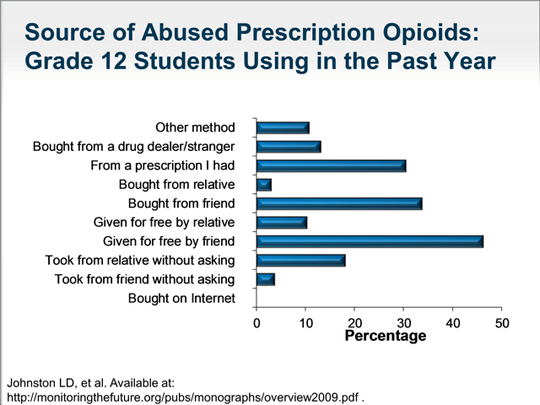
Here are some alarming statistics:

image

In this slide, shamelessly stolen off the Medscape Continuing Education activity, you see that buying drugs from a dealer is far less frequent that getting them from a friend or taking them from a relative.  The internet pharmacies that were supposed to ruin America do not make a significant contribution.

This next slide (also stolen) should make us proud.  It shows that America’s youth are more generous than Canadian youth.

image

What all this means is that we need to start teaching the risks of drug misappropriation to our patients.  Even though they may know their own family,there are many people who have figured out that scoring drugs from an elderly confused patient is cheaper and less risky than buying them from a dealer.   We should teach patents or assist them in putting narcotic pain relief out of sight or under lock and key.  We should teach them proper disposal of medications.  And if there is any suspicion of misappropriation, pills should be counted just as they are in the hospital or other setting.

I really encourage you to take advantage of this free continuing education from Medscape and use it in your practice.  It doesn’t take long and it may open your eyes to a threat you never considered before and allow you take action before someone gets hurt.

Plus if you take thefree continuing education activity, Medscape will be less likely to write me nasty letters for stealing their stuff.  I prefer to download the transcript but there is a video discussion for those of you who do not like to read.

By the way, don’t start talking about ‘Julianne, you know, the nurse who loves Morphine’.  It just doesn’t sound right.